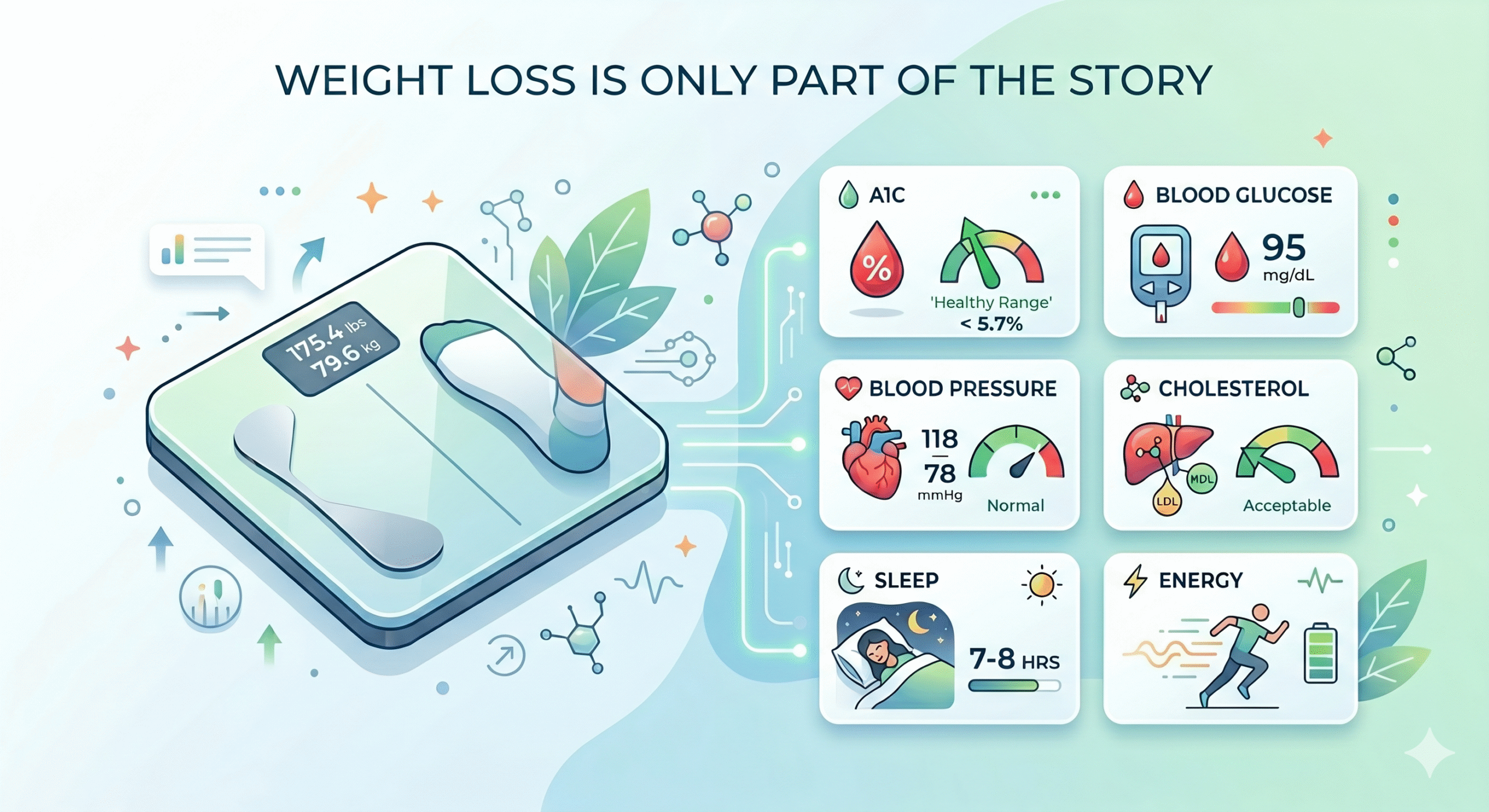
The Role of At-Home A1C Testing in Solving The GLP-1 Adherence Challenge
We acknowledge the seismic shift GLP-1 drugs represent, making them an unavoidable topic at conferences like JP Morgan Healthcare. However, these drugs alone—even as their use expands beyond diabetes—are not a complete solution, as GLP-1 therapies carry a high risk of non-adherence.
True value lies not just in the drug itself, but in the ecosystem that can support its sustained use. Orange Biomed examines converging strategies—from the shift to oral formulations to the integration of at-home rapid A1C tests for monitoring—that have the potential to unlock this multi-billion-dollar adherence opportunity, creating a new standard for chronic disease management.

New Blockbuster GLP-1 Opportunities

GLP-1 receptor agonists are expanding beyond diabetes and obesity. They have demonstrated significant reductions in major adverse cardiovascular events (MACE), a benefit partly independent of weight loss.
GLP-1s are now positioned to address broader cardiometabolic syndrome, thereby expanding the treatable patient population.
This diversification de-risks the asset class by creating multiple revenue streams. It positions the potential of GLP-1 platforms as the foundation for a new era of systemic metabolic medicine.

The New Reality of Use Case Zero - Diabetes Management

With additional indications under development, the GLP-1 manufacturers are working to sustain growth and adherence in their Use Case Zero – Diabetes and Obesity Management. In reality, adoption is shifting from treatment initiation for Early Adopters to the rest of the market, exposing GLP-1 to a less-than-enthusiastic user base while creating a massive opportunity for enabling technologies.
Unfortunately, even Early Adopters discontinue their treatment in staggering numbers. Based on recent large-scale studies, discontinuation rates for GLP-1 medications are notably high:

GLP-1 Discontinuation Rates: Summary of Published Studies

Patient Population1-Year / 3-Year Discontinuation RateSource
Patients with Type 2 Diabetes (using GLP-1 RAs)23.6% at 1 year; 38.5% at 3 years Diabetologia , (2025)
Patients with Overweight/Obesity (using semaglutide for weight loss)64.8% at 1 year; 3-year data not available in study JAMA Network Open (2025)
Older US Adults with Diabetes (on Medicare, using injectable semaglutide)59.5% at 1 year; 3-year data not available in study JAMA Cardiology (2025)

The Two Pillars of Lapsed GLP-1 Adherence

For patients to experience the full benefits of GLP-1 medications, consistent, long-term use is key.There are two key factors that impede adherence and growth: “needle phobia” and patients’ waning motivation to sustain treatment without quickly visible results.
What are the two most likely solutions that can help reduce these barriers to adoption and growth?

1) The Strategic Shift to GLP-1 Pills and Patches to Fight “Needle Phobia”

The move to pills and patches is one strategy to overcome two significant barriers to GLP-1 usage: inconvenience and needle aversion.
For many potential patients, the requirement for regular injections is a deterrent. Pills offer a more familiar and less invasive method of treatment, which is expected to attract a new segment of users and overcome “Needle Phobia.”
This convenience is a major factor in the sharply rising market forecasts. The global market for weight-loss medications is now projected to reach $150 billion by 2035, a substantial increase from earlier projections of $105 billion[1]. Non-injection medications are one component of achieving this growth.

2) Visible Results and a Positive Feedback Loop to Cut GLP-1 Discontinuation

One method to unlock adherence is to  combine these breakthrough drugs with patient-centric tools, like at-home A1C testing. Establishing a quarterly monitoring rhythm with a convenient at-home A1C device can create a powerful positive feedback loop, transforming a static treatment plan into a dynamic strategy for sustained health management.
While a patient’s overall treatment regimen—including whether more frequent A1C monitoring is appropriate—should always be guided by their healthcare provider, this approach can shift the patient experience from a passive, often frustrating waiting game to an active, data-driven journey.

How to Improve GLP-1 Adherence with an At-Home A1C Test

Patients can improve GLP-1 adherence by using a portable A1C test to obtain immediate, tangible proof of progress. Instead of soley relying on semi-annual doctor’s visits for feedback, patients can now directly observe the results of their commitment. This regular, quarterly confirmation of progress—seeing their A1C numbers fall or stay low—can help serve as a powerful motivator, validating their efforts and reinforcing the value of staying the course with their treatment plan.
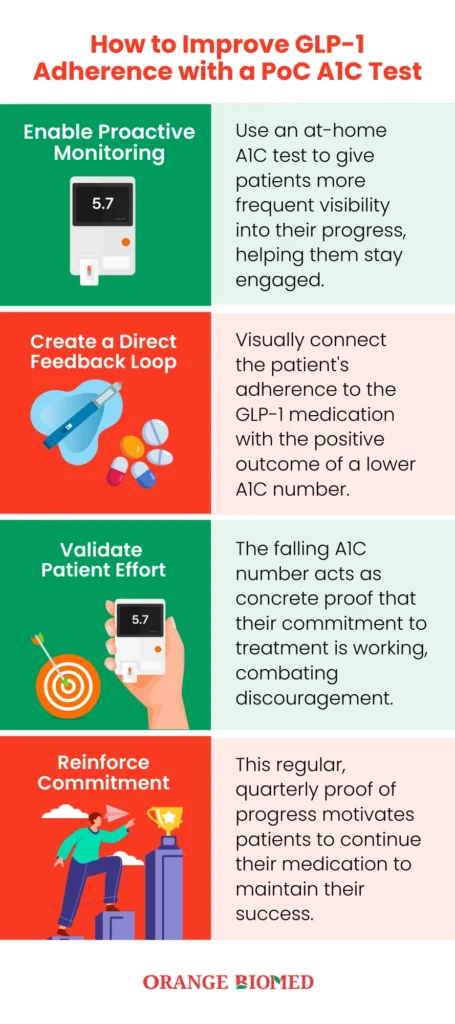
Here is how to use an A1C test to help improve GLP-1 adherence:
Providing an accurate portable at-home A1C test to new patients or those who have lapsed on their prescription may significantly increase adherence with a very small additional investment by the drugmakers.
It is crucial for patients and providers to recognize that not all A1C tests are created equal, as accuracy can vary significantly between at-home products, and traditional A1C tests are not always reliable for minorities due to hemoglobin variants.
Many direct-to-consumer tests are susceptible to environmental factors and user error, potentially leading to misleading results that could compromise care decisions. In this landscape, the OBM rapid A1c test is being developed for professional use or highly controlled self-testing, prioritizing higher reliability.

The Augmented Portable A1C Device: The Critical Data Link

In this context, a portable A1C device is not a mere gadget, but a means of unlocking data.
  • From Diagnosis to Continuous Management: The OBM rapid A1c meter is a tool to support the new era of care. It is being designed to enable convenient, regular checks of the gold-standard metric for long-term glucose control (the A1C test), which is crucial for managing chronic conditions.
  • The Power of At-Home Testing: Moves diabetes management along with the market trend toward at-home testing. Our portable device aims to provide immediate results anytime, anywhere—within patients’ homes, on the road, and other settings—supporting more proactive patient monitoring  and informed discussions with providers based on results. This aligns with the larger digital health trend of moving care out of the lab and closer to the patient.
  • Generating the Data Ecosystem: This is the key value proposition. Our device has the potential to of generate a continuous stream of lab-quality A1C data. This data can help:
    • For Providers: Monitor the effectiveness of GLP-1 therapy and guide treatment decisions.
    • For Payers: Provide tangible evidence of a drug’s success in improving patient health outcomes and demonstrating long-term ROI, which is crucial for justifying the high cost of therapy and supporting value-based contracts.
    • For Pharma Companies: Offer real-world evidence on drug performance.

The Payer's Imperative: Demonstrating Long-Term Value and ROI

For payers facing enormous costs for GLP-1 therapies, the central question is one of long-term value. They will increasingly demand proof of sustained efficacy and a clear return on investment (ROI) that extends beyond initial weight loss. Improved glycemic control, as measured by A1C, is a proven, objective metric that correlates with reduced long-term complications and costs.
An at-home A1C test with lab-accurate results provides the missing data link. It offers a scalable way to demonstrate that these expensive drugs are delivering on their promise of lasting health improvement. Seamless and secure sharing of validated A1C data will provide payers with the evidence they need to confidently support these transformative therapies.

What Can You Do for GLP-1 Adherence and Patient Adoption Acceleration

In conclusion, while GLP-1 therapies represent a monumental leap forward, their long-term success is tied to patient adherence. Overcoming barriers like needle aversion and motivational decline can be solved by utilizing a dual-pronged approach: advancing drug formulations and integrating enabling technologies.
For a pharmaceutical company, what is the business case for bundling an adherence tool like an at-home A1C test with a GLP-1 drug?
The business case is strong and multi-faceted, representing a promising path forward:
  • Increase Patient Lifetime Value (LTV): By improving adherence by even a few months, the revenue from a single patient increases substantially, far outweighing the marginal cost of the test.
  • Differentiate in a Crowded Market: As more GLP-1s enter the market, providing a proven adherence solution becomes a powerful competitive advantage and value proposition for payers and providers.
  • Generate Real-World Evidence (RWE): Aggregated, anonymized A1C data provides powerful RWE on drug performance in a real-world setting, supporting value-based contracts and marketing claims.
  • Direct Patient Relationship: It creates a channel for education, support, and loyalty, moving beyond a purely transactional relationship with the healthcare system.
  • De-risk Payer Negotiations: Providing tangible, objective proof of glycemic efficacy directly addresses the payer’s demand for demonstrated ROI, facilitating better formulary positioning and reimbursement.

Partner with Orange Biomed

For GLP-1 manufacturers seeking to secure their market position and for healthcare providers dedicated to improving patient outcomes, a promising solution lies in creating a tangible feedback loop.
If you are ready to address the adherence challenge directly, we invite you to reach out to discuss how Orange Biomed’s portable OBM rapid A1c can be incorporated into your future treatment protocols or drug ecosystem to demonstrate value, validate efficacy, and keep patients motivated and engaged in their health journey.
[1] https://pubmed.ncbi.nlm.nih.gov/40746073/ “Editorial: Global Obesity Rates Continue to Rise with Challenges for New Drug Treatments Including GLP-1 Receptor Agonists”

FAQs

1. How high is the discontinuation rate for GLP-1 drugs like Ozempic and Wegovy?
Discontinuation rates are high, with one study showing nearly 65% of U.S. patients who take it for weight loss stop treatment within a year. In patients with Type 2 diabetes 23.6% will stop within a year, however 38.5% will eventually quit after 3 years.
2. What are the most common reasons people quit taking GLP-1 medications?
GLP-1 discontinuation reasons include gastrointestinal side effects, cost, and waning motivation without visible results.
3. What happens to your body when you stop taking GLP-1 agonists?
Studies indicate that most people who stop treatment regain a significant portion of the weight, as these medications manage a chronic condition.
4. What strategies help patients stay motivated on long-term GLP-1 therapy?
Creating a positive feedback loop with tangible data is a powerful motivator. Using tools like at-home A1C tests provides immediate, visual proof of metabolic improvement (e.g., a lower A1C number), validating the patient’s effort and reinforcing the treatment’s value between doctor’s visits. Studies confirm that patients who see an early response are more likely to stay on their medication.
5. What is the “stop-start” cycle with weight loss drugs, and why is it harmful?
The “Start-Stop” cycle is clinically and economically detrimental:
Clinically: It leads to rapid weight regain and the reversal of glycemic and cardiovascular benefits, potentially putting patients back at baseline risk or worse. This yo-yoing can be discouraging and harmful.
Economically: For the healthcare system, it represents the worst of both worlds: incurring the high drug cost without realizing the long-term cost savings from preventing complications (e.g., heart attacks, kidney disease). For the pharmaceutical company, it jeopardizes the lifetime value of a patient and increases the cost of customer acquisition.
6. How do insurance companies decide who qualifies for GLP-1 drug coverage?
Payers use strict prior authorization (PA) requirements to control costs. They often require detailed documentation proving a patient meets specific criteria, such as BMI thresholds, previous diet/exercise attempts, and comorbid conditions. Payers are increasingly demanding proof of long-term efficacy and ROI beyond initial weight loss, which ties directly to improved health metrics like glycemic control.
7. What is the biggest barrier to GLP-1 adherence?
The biggest barrier is waning patient motivation, often caused by weight loss plateaus and the lack of immediate, tangible feedback. Without visible proof that the medication is still working internally, patients become discouraged and discontinue treatment.
8. What are the signs a patient is at risk of stopping their GLP-1 treatment?
High-risk patients often present with a combination of:
  1. Psychological Profile: A history of all-or-nothing thinking, low frustration tolerance, or previous discontinuation of other chronic medications.
  2. Social Determinants of Health: Unstable housing, food insecurity, or low health literacy.
  3. Clinical Presentation: Expressed anxiety about injections or a primary motivation driven solely by a single event (e.g., a wedding) rather than long-term health.
  4. Early Treatment Response: Patients who report minimal side effects and minimal perceived benefit in the first 3 months are at a significantly higher risk of lapsing.
9. What are the red flags for GLP-1 non-adherence during a patient visit?
Here are the key red flags for GLP-1 non-adherence that clinicians should identify during a patient visit:
Behavioral & Motivational Red Flags
Expressing Discouragement: Comments like “I don’t feel like it’s working anymore” or “the results have slowed down” indicate waning motivation.
Focusing Solely on Weight: A patient who is overly frustrated by normal weight loss plateaus and doesn’t value other metrics (like A1C improvement) is at higher risk.
Minimizing the Condition: Stating they “feel fine” and questioning the ongoing need for medication suggests a lack of understanding of the chronic nature of their disease.
Practical & Clinical Red Flags
Frequently Rescheduling Appointments or missing follow-ups entirely.
Reporting Minimal Side Effects: While counterintuitive, reporting no initial nausea or GI effects can sometimes indicate the patient never started or is taking a sub-therapeutic dose.
Consistent Lack of Progress: No weight loss or improvement in glycemic markers (like A1C) after 3 months, assuming the prescription was filled.
Hesitancy or Negative Talk about Injections, or repeatedly asking, “When will a pill be available?”
Situational Red Flags
Newly Emerging Cost Concerns or confusion about insurance coverage.
Significant Life Stressors (e.g., job loss, change in routine) that can disrupt medication habits.
Identifying these signals early allows for proactive intervention, such as integrating an at-home A1C test to create a positive feedback loop or discussing solutions for injection anxiety, to get the patient back on track.
10. Are there tools or technologies that can improve adherence to GLP-1 medications?

Yes, several tools may help support GLP-1 adherence by addressing key barriers like motivation and convenience. The most effective include:
At-Home A1C Test Kits: These provide objective, tangible feedback of metabolic improvement (a lower A1C number), creating a powerful positive feedback loop that validates the patient’s effort and support engagement.
Digital Health Platforms & Apps: These offer dose reminders, progress tracking, and educational content to support daily habit formation.
Non-Injection Formulations: The development of oral pills and patches directly addresses “needle phobia” and injection fatigue, a major reason for discontinuation.
Integrating these tools into a patient’s treatment plan can help shift a static prescription into a dynamic, supportive ecosystem for long-term success.

Recommended Next Steps Per Yeaseul’s Question:

OBM Question: Do you think SEO performance would improve if we referenced GLP-1 brand names like Ozempic, Wegovy, and Mounjaro more frequently? At the moment, the core content focuses on GLP-1 broadly, with brand mentions limited to the FAQ.”
BDMT Answer: It depends on the target audience. At this moment, we targeted the industry/ecosystem of players likely to attend JPM Health, making the article less promotional for the brands and less “mass-market”-oriented.
Peppering the brand names and adding questions to the FAQs section with those brand names will make the article feel like a commercial (different intent) and will be distracting from the conceptual thought leadership.
Of course, the search volumes for the brand names such as Ozempic, Mounjaro exceed that of GLP-1, and adding them in AFTER JPM Health would further increase the SEO position of the article. Given how close we are to JPM Health, there is a very low chance that the article will gain top spots in ranking for the commercial brand names (very competitive keywords).
BDMT’s recommendation is to:

a) Publish the article as is for the JPM Health audience.
b) Promote the article via social media to the JPM Health audience that cover it.
c) After JPM, the article can be further updated to satisfy more mainstream “branded” search
d) Adding the brand names will need to be done carefully, so as not to increase keyword density.

Branded names to include:
“Big Three” (Ozempic, Wegovy, Mounjaro) to be integrated in the article
We will need a number of general questions for Q&As about the GLP-1 to properly and unobtrusively add all brand names, such as:
  • Semaglutide (Ozempic, Wegovy, and Rybelsus, Novo Nordisk)
  • Tirzepatide (Zepbound and Mounjaro, Eli Lilly)
  • Dulaglutide (Trulicity, Eli Lilly)
  • Liraglutide (Victoza and Saxenda, Novo Nordisk)
  • Exenatide (Byetta and Bydureon BCise, AstraZeneca), and
  • Lixisenatide (Adlyxin and Soliqua, Sanofi)

For example, such a question might be about the difference in GLP-1 indicated for Diabetes vs. Chronic Weight Management. An easy-to-follow table based on FDA indications would be good to include.